Why Farm Managers Choose Software To Cut Costs
Farm managers face rising costs for fertilizer, seeds, fuel, and crop protection products, along with unpredictable commodity prices and labor shortages. These challenges make maintaining profitability tough. Many farms still rely on outdated methods like spreadsheets and paper records, which are error-prone and time-consuming.
Farm management software offers a solution by automating tasks, improving precision, and reducing waste. Here's how it helps cut costs:
- Lower Input Costs: GPS mapping and variable-rate applications reduce overlaps and unnecessary inputs like seeds and chemicals.
- Fuel and Machine Savings: Route planning minimizes fuel use, road miles, and wear on equipment.
- Labor Efficiency: Centralized job scheduling and automated records reduce miscommunication, rework, and payroll errors.
- Long-Term Insights: Historical data analysis helps refine practices, improve yields, and manage budgets.
Platforms like HarvestYield simplify operations by combining GPS tracking, job scheduling, and machine cost tracking, helping farms reduce expenses and improve decision-making.
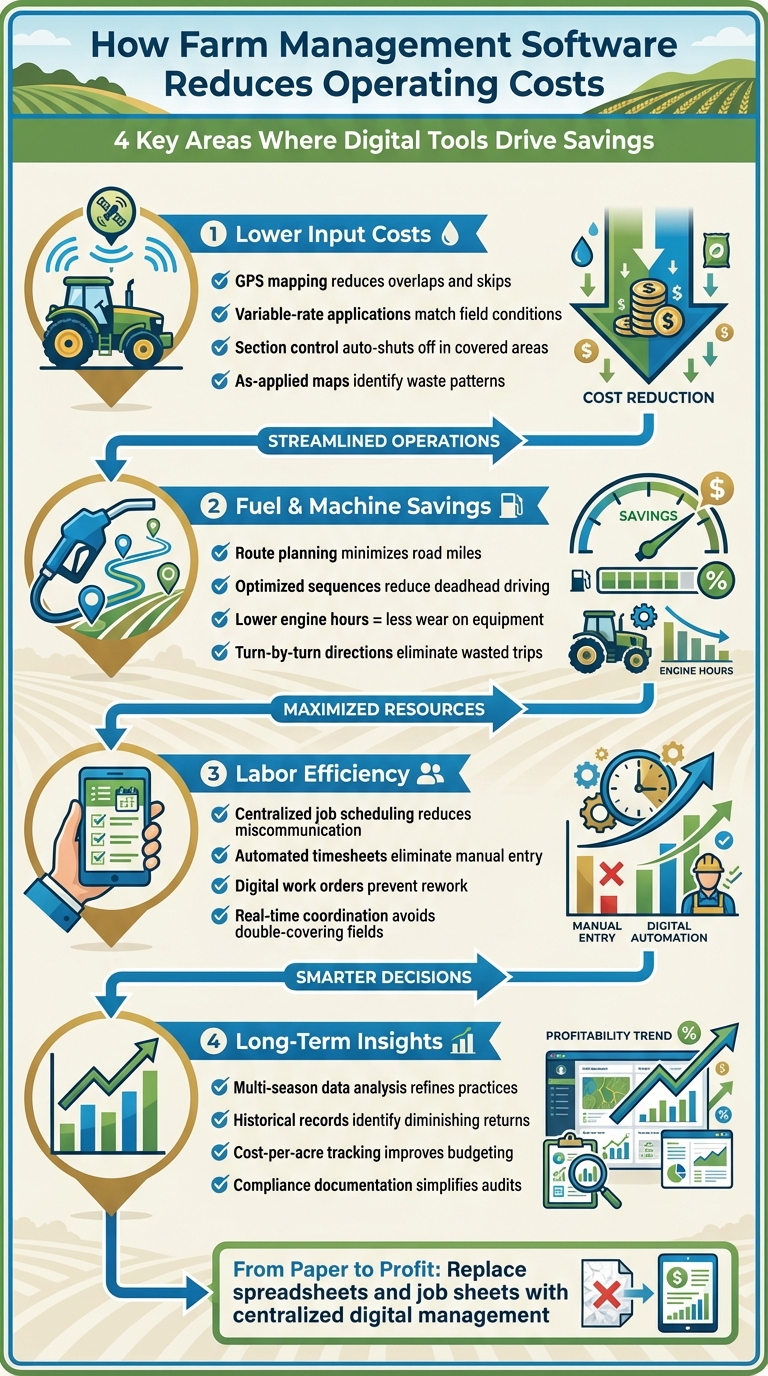
How Farm Management Software Reduces Operating Costs: 4 Key Areas
Profit Manager- Cost of Production Farm Tool!
How Farm Management Software Reduces Input Costs
For U.S. row-crop farms, managing variable costs like seeds, fertilizers, and crop protection products can be a challenge. When these inputs are applied without precision - such as across generic field blocks without clear boundaries or tracking - waste often occurs through overlaps, skips, or blanket applications that don’t account for actual field conditions.
Farm management software tackles these inefficiencies head-on. By using GPS to create field maps and track every pass, it overlays data like soil types, yield history, and crop zones. This allows the software to generate variable-rate prescriptions, which increase inputs in high-yield areas and reduce them in less productive zones. The result? Lower overall input usage while maintaining yields. These tools lay the groundwork for the more detailed strategies outlined below.
Field Mapping and GPS Data for Accurate Applications
Accurate field boundaries are key to cutting costs. By mapping each field’s exact shape, acreage, and obstacles, managers can create precise guidance lines and headland patterns for equipment operators. GPS-guided systems ensure operators avoid overlaps and skips during planting, fertilizing, and spraying. For instance, a sprayer boom can stay within the previous pass, preventing double-spraying headlands or missing strips altogether.
Many platforms also offer section or swath control, which automatically shuts off planter rows or sprayer sections as they enter areas already covered. This feature reduces over-application of seeds and chemicals, especially along field edges. After each job, as-applied maps provide color-coded layers showing where inputs were applied and at what rates. These maps make it easy to identify gaps, overlaps, or calibration issues that need fixing before the next operation.
Take HarvestYield, for example. This platform enables users to map fields by driving around them or dropping pins, while GPS tracks job coverage. It also records the exact amount of inputs - like fertilizers, seeds, or chemicals - used for each task. With its combination of field mapping, GPS navigation, and real-time coverage tracking, HarvestYield ensures precise input application, minimizing waste.
Better Planning to Reduce Input Waste
Preseason planning tools help managers set crop targets, yields, and input programs, creating a clear budget before purchases are made. The software aggregates total product needs across fields, helping avoid over-purchasing. This prevents excess inventory that might expire or be used unnecessarily just to clear out stock - a common source of waste.
During the growing season, tools that track water stress, soil moisture, and local weather guide the timing of fertilizer and crop-protection applications. By aligning these applications with rainfall or pest and disease pressure, managers can reduce the number of applications while minimizing losses from leaching or volatilization. Historical yield data, soil tests, and scouting insights further allow the software to recommend variable-rate applications. This ensures that seeding and fertilization match each zone’s yield potential, avoiding the inefficiency of blanket rates.
The software also provides analytics on inventory and input usage by field and crop. This helps managers identify unusually high product use per acre or bushel, prompting adjustments to rates, timing, or product selection in future plans. Over time, these data-driven tweaks reduce input use per acre while maintaining - or even improving - yields. This not only saves money but also boosts long-term efficiency.
Route Planning to Save Fuel and Machine Hours
Route planning tools streamline field visits for tractors, sprayers, and spreaders. By organizing tasks in a logical sequence, the software reduces unnecessary travel, cutting down on road miles and fuel consumption. Optimized routes also minimize overlapping passes, deadhead driving, and idling, which lowers engine hours and wear on machinery like tires and drivetrains. This approach reduces fuel costs while improving input efficiency.
Platforms like HarvestYield take this a step further by offering turn-by-turn directions to field locations and displaying maps of scheduled jobs. Dispatchers can assign the closest machine to the next task and reroute equipment around traffic, weather, or access issues, avoiding wasted time and fuel. The platform also tracks repair, servicing, and refueling costs, providing a full picture of machine-related expenses, including fuel use.
How Software Improves Labor and Administrative Efficiency
Farm management software helps tackle labor inefficiencies and administrative delays, which are often significant cost drivers in U.S. row-crop operations. Labor expenses include wages, benefits, and the time managers spend coordinating crews and handling paperwork. When workers are left waiting for instructions, fields are mistakenly worked twice, or office staff spend hours reconciling paper timesheets, costs can spiral. Software steps in by centralizing job scheduling, automating record-keeping, and improving real-time team coordination.
Centralized Job Scheduling and Task Assignments
Centralized job scheduling provides managers with a real-time overview of tasks, workers, and equipment, allowing them to assign jobs more efficiently. Instead of relying on phone calls or paper lists, managers can make assignments based on availability, location, and priority. Digital work orders include instructions, locations, and deadlines, reducing delays caused by miscommunication or missing details. For example, managers can monitor the real-time locations of sprayers and operators and instantly update plans to prevent downtime. Over time, this leads to more acres covered per labor hour and fewer idle hours on payroll.
Tools like HarvestYield offer mobile apps that send live job updates directly to field operators. Workers can view scheduled tasks on a map and receive turn-by-turn directions to each field, eliminating confusion about where to go next. This increased visibility allows managers to redirect the nearest machine to a task or reroute equipment to avoid delays caused by traffic, weather, or access issues. This digital synchronization also integrates with automated record-keeping, further reducing administrative bottlenecks.
Automated Job Records and Timesheet Management
Automated systems capture key job details - such as field, crop, task, operator, machine, timestamps, and GPS data - reducing manual errors. When workers log task start and end times via a mobile app, the system automatically generates digital timesheets that managers can review and approve. This eliminates the need for paper job sheets, manual logbooks, or spreadsheet-based tracking, which are prone to mistakes and delays.
For operations paying hourly workers, this automation simplifies payroll by summarizing approved hours per employee and job, cutting down on the time spent by bookkeepers on data entry and reconciliation. Additionally, these records allocate labor and machine costs to the correct cost centers, aiding in cost-of-production analysis. For contractors and custom operators, these digital records enable detailed invoicing, such as billing a client for 150 acres sprayed at a per-acre rate, complete with GPS paths and timestamps to resolve any disputes. HarvestYield enhances efficiency by recording job details along with GPS and weather data, significantly reducing the administrative workload tied to labor cost tracking.
Reducing Rework Through Better Coordination
By combining centralized scheduling and automated record-keeping, software helps prevent costly rework. Real-time coordination ensures clear task boundaries, priorities, and rates, reducing the likelihood of errors like double-covering, skipping rows, or misapplying inputs. Managers can track progress in real time and receive alerts about issues, such as crews entering the wrong field or equipment malfunctions, allowing them to address problems before they escalate.
Examples of avoidable rework include re-spraying fields after an incomplete pass, re-harvesting missed areas, adjusting fertilizer rates due to miscommunication, and fixing overlaps or gaps in equipment coverage. Since rework consumes resources without increasing yield, even minor reductions in these errors can significantly lower operating costs per acre. Platforms like HarvestYield provide detailed job instructions, mapping, and GPS records, giving managers the assurance that tasks are completed correctly the first time. This reduces disputes and eliminates unnecessary repeat work.
Transform Your Agricultural Team
Streamline job management, field mapping, and machine tracking with HarvestYield. Simplify your operations and eliminate paper job sheets.
ContinueUsing Data and Records for Long-Term Savings
Farm management software creates a detailed historical record that helps refine operations and increase profitability over time. By storing yield data, input applications, labor hours, machine costs, and weather conditions in one centralized digital system, managers can uncover patterns and insights that paper records or scattered spreadsheets often miss. This multi-year perspective transforms raw data into actionable strategies - highlighting which fields consistently deliver strong margins, where inputs reach a point of diminishing returns, and how different practices hold up under varying weather conditions. These insights not only enhance day-to-day decisions but also shape long-term strategies for success.
Centralized Historical Data for Better Decisions
A centralized digital system replaces the hassle of fragmented paper files and stand-alone spreadsheets, making all records instantly accessible. Managers can quickly review which fields are most profitable, pinpoint areas with excessive input use, and assess weather impacts - all from one platform. Many farm management tools come with built-in analytics and dashboards, turning historical data into visual insights like yield trends, cost-per-acre breakdowns, or gross margins per bushel. These tools help guide smarter decisions. For instance, platforms like HarvestYield link each operation to its specific field and season, creating a comprehensive historical record that’s easy to analyze.
Refining Practices Through Multi-Season Analysis
Historical data enables managers to fine-tune their strategies over time. By analyzing several seasons of data, they can identify diminishing returns from higher input rates. For example, applying 220 lb/acre of nitrogen may not yield enough extra bushels to justify the cost compared to 190 lb/acre. This kind of data also supports variable-rate applications, where software uses past performance and soil or satellite data to apply fertilizer more efficiently - targeting areas that respond well while scaling back in zones with poor returns. This reduces waste and boosts profitability per acre. Additionally, multi-year spray and scouting records allow managers to compare proactive versus reactive approaches to fungicide or insecticide use. This helps cut unnecessary applications, lower chemical costs, and maintain yields. By tracking yield, inputs, and margins over multiple seasons, managers can also evaluate crop rotation patterns - like corn–soybean–wheat versus continuous corn - and determine which sequence delivers the best balance of yield, input efficiency, and net return per acre.
Budgeting and Compliance Benefits
Long-term data doesn’t just improve operations - it also strengthens budgeting and compliance efforts. Farm management software can compile years of yield, price, and cost records to calculate average revenue and cost per acre for each crop and field, helping managers build realistic budgets and enterprise plans in USD. Tracking expenses per acre allows for real-time adjustments to operations. Digital records also simplify compliance with pesticide, safety, water usage, and traceability standards. Managers should document details like product names, rates, EPA registration numbers, application dates and times, field locations, weather conditions during spraying, operator names, and equipment used for all chemical applications. Many software platforms make it easy to export spray logs, field histories, and harvest records, which can satisfy audits for processors, food safety programs, or sustainability certifications. This reduces administrative time, lowers the risk of non-compliance penalties, and helps preserve valuable contracts.
How HarvestYield Supports Cost Reduction in Farm Management
HarvestYield takes the cost-saving strategies farm managers rely on and brings them to life through a single, streamlined platform. By combining job scheduling, GPS tracking, field mapping, and machine cost analysis, it eliminates the need for paper job sheets and scattered spreadsheets. This digital approach simplifies farm operations, helping U.S. farm managers and contractors reduce expenses on labor, inputs, fuel, and equipment - all without complicating their daily routines. Here's how HarvestYield's features deliver these savings directly in the field.
Job Scheduling and Real-Time Tracking
HarvestYield's job board allows managers to assign tasks that field staff can access instantly on their smartphones. Each job includes turn-by-turn directions to field locations, cutting down on wasted time and communication errors that drive up labor costs. Real-time updates keep managers informed of job progress, enabling them to spot delays early and redistribute workloads to avoid overtime expenses.
Every job is logged with precise timestamps, detailing which workers and machines were involved. This data helps managers compare planned hours to actual time spent, fine-tuning future schedules and crew sizes to better align with labor needs. For custom operators, having a clear view of all field locations reduces unnecessary driving, cutting fuel use and nonproductive time.
GPS mapping takes these efficiencies even further by reducing waste in input usage.
GPS-Based Job Recording and Field Mapping
When a job is completed using HarvestYield, the platform records the GPS path of the machine in action. This allows managers to compare planned acres with actual GPS-tracked coverage, ensuring inputs are used as efficiently as possible. If discrepancies arise, adjustments can be made to optimize rates.
HarvestYield also simplifies field mapping by storing precise acreage values linked to specific clients and fields. Contractors benefit by billing based on exact mapped areas rather than estimates, which helps prevent under-billing that can chip away at profits. Additionally, GPS job traces provide hard evidence of completed work, offering transparency when clients question charges.
Operational savings don't stop there - machine cost tracking adds another layer of efficiency.
Machine Cost Tracking and Analysis
HarvestYield keeps detailed records of repairs, servicing, and refueling for each piece of equipment, building a comprehensive usage history. This data shows how many hours or acres a machine has worked over time. By factoring in fuel, maintenance, and ownership costs, managers can calculate the cost per machine hour or per acre for key operations. This insight highlights which machines are driving up expenses and where adjustments might be needed to maintain profitability.
When repair costs start to rival replacement expenses, these records provide solid evidence to justify upgrading equipment. They also reveal under-used machines that could be sold or shared, freeing up capital while ensuring enough equipment is available for critical tasks.
Conclusion
Farm management software takes the guesswork out of running a farm by streamlining operations and cutting unnecessary costs across inputs, labor, and machinery. With precision tools, inputs like fertilizer, seeds, and chemicals are applied only where they're needed, reducing waste. Centralized scheduling and automated record-keeping replace outdated paper job sheets, minimize miscommunication, and help curb overtime hours. Plus, tracking machine costs helps identify which equipment is driving up expenses and whether it’s time to repair, replace, or repurpose.
But the real advantage of platforms like HarvestYield extends beyond immediate cost savings. Over time, these tools provide valuable insights for better decision-making. By analyzing multi-season data, managers can pinpoint which fields, crops, and practices consistently deliver the best returns. This shift from reacting to problems as they arise to planning based on data reduces risks and helps maintain profitability - even when input prices or labor costs climb.
For farms aiming to stay competitive, management software isn’t just a tool - it’s a game-changer. Features like job scheduling, GPS tracking, and machine monitoring turn the platform into a daily resource for smarter decisions. This proactive, data-driven approach helps eliminate waste, boost profits, and ensure long-term success.
FAQs
How can farm management software help lower operating costs?
Farm management software is a game-changer when it comes to cutting operating costs and keeping things running smoothly. By replacing paper job sheets with digital tools, it simplifies scheduling and keeps teams organized and focused.
With tools like machine cost tracking and GPS-based job recording, farm managers can keep a closer eye on fuel usage, labor hours, and repair costs. This means better resource allocation and more efficient team coordination, ultimately saving both time and money while ensuring operations stay on track.
How does GPS mapping help improve farm operations?
GPS mapping has become an essential tool in modern farm management, providing precise field measurements and accurate navigation. It makes it easier to pinpoint the location of fields, equipment, and other important assets, cutting down on wasted time and minimizing unnecessary travel.
By using GPS mapping, farm managers can streamline their operations, avoid overlaps, and optimize the use of resources such as fuel, labor, and machinery. The result? Lower costs and smoother workflows for the entire team.
How does farm management software help improve labor efficiency?
Farm management software helps make farm operations run more smoothly by improving how tasks are planned, tracked, and communicated. Instead of relying on paper job sheets, these tools provide clear digital maps, streamline task assignments, and allow real-time monitoring of progress. This not only cuts down on mistakes but also makes it easier for teams to stay connected and on the same page.
With features like GPS tracking and integrated weather updates, managers can assign tasks with better precision and ensure workers are fully equipped to handle their jobs. The result? More efficient workflows, higher productivity, and valuable time saved for everyone involved.